Posted on Leave a comment

2016 BEST PHOTOGRAPHY BOOKS by Elisabeth Avedon on his Journal Blog, here the link: http://elizabethavedon.blogspot.com/2016/12/best-2016-photography-books-round-up.html

MY LAGOS by Robin Hammond

Middle class and wealthy families enjoy Elegushi Private Beach. With an estimated 21 million inhabitants, Lagos is Africa’s biggest city in the continents most populous nation. And its population is increasing faster than almost any other in the world. Lagos is home to the richest people in the richest country in sub-Saharan Africa (excluding of South Africa), but the riches have hardly trickled down, it is also one of the most unequal cities in the world (ranked in the top three most unequal for income earned). The huge numbers of poor eking out a living here make this the 4th worst place to live in the world. But not for everyone – Lagos has seen a rapidly rising middle class and this city of enormous contrasts is fast becoming internationally known as Africa’s hub of creativity, fashion and business. 16 June 2013. Photo Robin Hammond/Panos

Publisher: Editions Bessard

Robin Hammond’s ‘My Lagos’ introduces us to the color, energy and chaos of Africa’s largest city. An original Nollywood film poster wraps this beautifully designed book delivering an authentic piece of the city to the audience. Full bleed color photographs take us on a journey through bustling Lagos streets and into the homes of the rich, poor, and rising middle class. ‘My Lagos’ opens our eyes to an Africa rarely seen in western media. Placed over and between these views of Lagos is a series of large format Polaroid portraits accompanied by quotes from the sitters themselves. A businessman, an actor, a fisherman, a pastor, a prostitute speak of their hopes and dreams in this city of strivers. ‘My Lagos’ is intense and bold….much like the city itself. Editions Bessard

Posted on Leave a comment

2017 sera Greenery, PANTONE Greenery: Elu couleur de l’année 2017-The Pantone #ColoroftheYear for 2017 is #Greenery. A refreshing and revitalizing shade, Greenery is symbolic of new beginnings

Pantone vient de dévoiler la couleur 2017. C’est un vert baptisé Greenery. Un vert tendre et printanier qui va inspirer la mode, la cosmétique, le lifestyle et les images des annonceurs en général.
The Pantone #ColoroftheYear for 2017 is #Greenery. A refreshing and revitalizing shade, Greenery is symbolic of new beginnings
Pantone said:
GREENERY
PANTONE 15-0343

A refreshing and revitalizing shade, Greenery is symbolic of new beginnings.

Greenery is a fresh and zesty yellow-green shade that evokes the first days of spring when nature’s greens revive, restore and renew. Illustrative of flourishing foliage and the lushness of the great outdoors, the fortifying attributes of Greenery signals consumers to take a deep breath, oxygenate and reinvigorate.

Greenery is nature’s neutral. The more submerged people are in modern life, the greater their innate craving to immerse themselves in the physical beauty and inherent unity of the natural world. This shift is reflected by the proliferation of all things expressive of Greenery in daily lives through urban planning, architecture, lifestyle and design choices globally. A constant on the periphery, Greenery is now being pulled to the forefront – it is an omnipresent hue around the world.

A life-affirming shade, Greenery is also emblematic of the pursuit of personal passions and vitality.

What is the PANTONE Color of the Year?

A symbolic color selection; a color snapshot of what we see taking place in our global culture that serves as an expression of a mood and an attitude.

Posted on Leave a comment

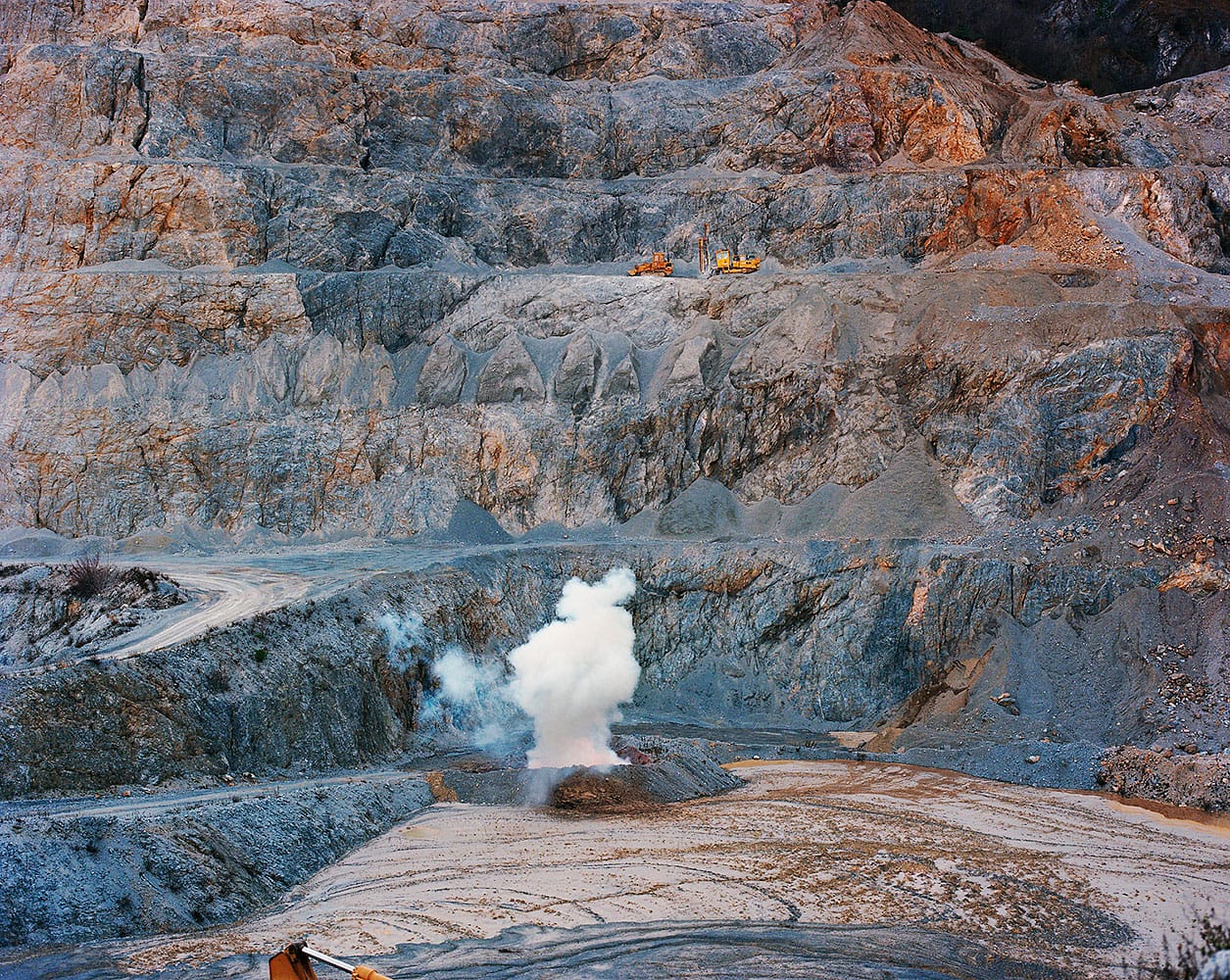
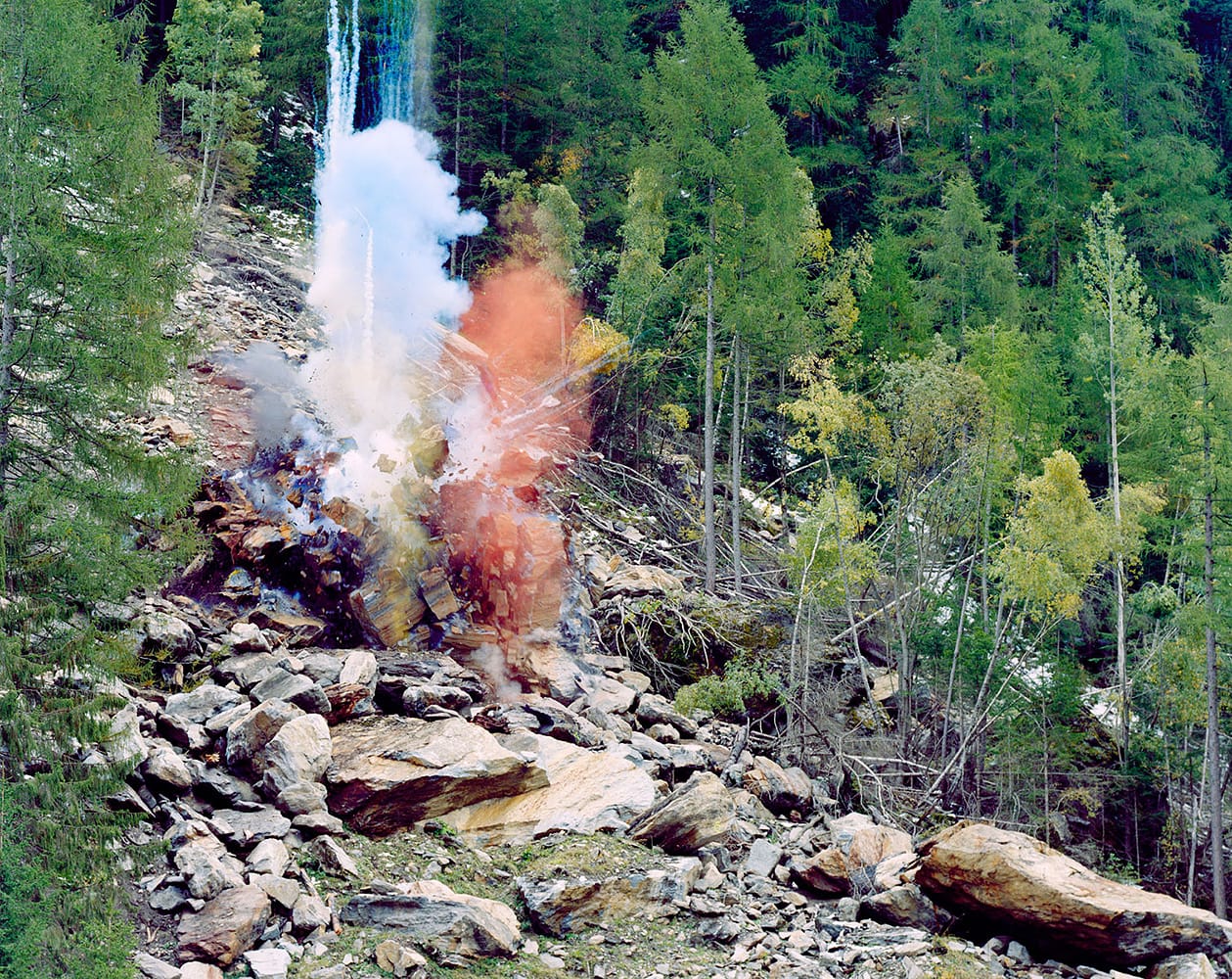
from Andrea Botto: I’m glad to share with you some news about my work, foretaste of 2017, which will be definitely the year of “KA-BOOM”, with the official launch of the book, published by Editions Bessard and the project of a traveling exhibition. As with my past projects, I work on collective imaginary, related to the explosion in this case, through the chameleonic power of Photography.
 KA-BOOM will be soon a photobook, published by Editions Bessard (Paris) in 2017, with the graphic design by Fabrizio Radaelli, and an exhibition project is coming.

KA-BOOM
I started to take pictures of explosions in Italy in 2008, as the global economy went down.
After having worked for long time on demolitions, landslides and other landscape transformations, it was an ideal evolution of my previous research about time, sense of limit and traces of collective memory.
You could say that I work on a sort of “aesthetic of destruction”, but I prefer to consider it as a natural and irreversible entropy.
Following the Police bomb squad motto, “Semel errare licet” (you can go wrong once) I take my pictures with a 4’x5’ viewcamera, so only one shot and good luck.
 The project aims at speaking about concepts like “time”, “limit” and “energy”, not only regarding the explosion, but also in the representation of a dissolution, as a metaphor of the destruction of contemporary world, in front of whom we seem to be only spectators, sometimes indifferent. A sublime spectacle that attracts and repels at the same time; painful, but maybe necessary to rebuild and renew.
andrea-botto_ka-boom33_corvara-in-passiria-2013_ed-7iiap
My first interest is the context where an event occurs, the scene surrounding the chaos, the social behaviors, more than the explosion itself. Indeed, the blast could even seem a fake or a bug inside the picture, suspended between staging and reality.
 About this, I really like that a lot of people ask me if my photographs are staged, even if they are not. It makes me wonder about our beliefs and expectations towards the images. Moreover, the distance of the point of view, the same of a curious bystander or that of the bomber delighting in the destruction he has created, remind us that looking is never a neutral act. Working on all these contraddictions is also a way to reflect on the ambiguity of the photographic language itself.
During the past years I carried out a lot of research on the uses of explosives, developing a personal approach to the subject and collecting informations and contacts with leading international experts. I studied a lot of books about explosives, especially their graphic design and pictures. I’ve had access to the historical archive of a big italian company that produced and commercialyzed explosives from the ‘50s to ‘90s and I became more and more interested in “functional” pictures, made only to show you something and to be what they are, without any artistic ambition. I started to mix all these stuffs with my pictures and I saw that it made the project more complex and ambigous.
andrea-botto_ka-boom-40_didcot2014

Then I began to stage and rephotograph some of these pictures, sometimes using myself as an actor. The instruments, the hands arranging something are all part of a kind of “performative” action. Someone told me that these pictures are the most disturbing part of the work, in some way, and I asked me why; mostly of the objects I have in my hands are not the real ones but fake models I made. The answer is that images, more than other media, depend on the context where we see them. So, the anxiety that we feel is not inside the picture but only in our eyes.
andreabotto-ka-boom-format_02
As with my past projects, I work on collective imaginary, related to the explosion in this case, through the chameleonic power of Photography.
 KA-BOOM will be soon a photobook, published by Editions Bessard (Paris) in 2017, with the graphic design by Fabrizio Radaelli, and an exhibition project is coming.

KA-BOOM #05, from the Studio Graziadei art collection, is currently on show at MACRO Museum in Rome, during the Fotografia Festival until January 8th, 2017, in the section dedicated to the past winners of the Graziadei Award. http://www.premiograziadei.org

Posted on Leave a comment

“My Lagos” by Robin Hammond one of the best photobook of the year again… for the November Book Club article, a list of photo-books recommended by Lee & Whitney Kaplan of Arcana Books. hope you enjoy & that it drove some traffic your way!

You can find a link to the post here: https://mag.citizensofhumanity.com/blog/2016/11/22/november-book-club/
My Lagos

Editions Bessard

An original Nollywood film poster wraps this beautifully designed book delivering an authentic piece of the city to the audience.
Lagos defies Western ideas of urban order. However, what looks like anarchic activity is actually governed by a set of informal yet ironclad rules. To a new comer to the city, these rules are an absolute mystery but in the shouting, and blaring of horns, and the pushing and shoving of crowds, everyone has a place to go and a way to get there.

Robin Hammond’s ‘My Lagos’ introduces us to the color, energy and chaos of Africa’s largest city. Full bleed color photographs take us on a journey through bustling Lagos streets and into the homes of the rich, poor, and rising middle class. ‘My Lagos’ opens our eyes to an Africa rarely seen in western media.

Placed over and between these views of Lagos is a series of large format Polaroid portraits accompanied by quotes from the sitters themselves. A businessman, an actor, a fisherman, a pastor, a prostitute speak of their hopes and dreams in this city of strivers.

Posted on Leave a comment

‘My Lagos’ a Limited Edition of 600 copies Each photobook is unique, fold by hand one by one, an original Nollywood film poster wraps this beautifully designed book delivering an authentic piece of the city to the audience.

The middle class neighborhood of Dolphin High Rise Estate, Ikoyi, Lagos, Nigeria. 27 March 2014.  With an estimated 21 million inhabitants, Lagos is Africa’s biggest city in the continents most populous nation. And its population is increasing faster than almost any other in the world. It also boasts the biggest economy of any city on the continent, if it were a country, it’s economy would be ranked the 5th biggest in Africa – ahead of Kenya. Lagos is home to the richest people in the richest country in sub-Saharan Africa (excluding of South Africa), but the riches have hardly trickled down, it is also one of the most unequal cities in the world (ranked in the top three most unequal for income earned). The huge numbers of poor eking out a living here have reportedly made this the 4th worst place to live in the world. But not for everyone - Lagos has seen a rapidly rising middle class and this city of enormous contrasts is fast becoming internationally known as Africa’s hub of creativity, fashion and business. Photo Robin Hammond/Panos
The middle class neighborhood of Dolphin High Rise Estate, Ikoyi, Lagos, Nigeria. 27 March 2014. With an estimated 21 million inhabitants, Lagos is Africa’s biggest city in the continents most populous nation. And its population is increasing faster than almost any other in the world. It also boasts the biggest economy of any city on the continent, if it were a country, it’s economy would be ranked the 5th biggest in Africa – ahead of Kenya. Lagos is home to the richest people in the richest country in sub-Saharan Africa (excluding of South Africa), but the riches have hardly trickled down, it is also one of the most unequal cities in the world (ranked in the top three most unequal for income earned). The huge numbers of poor eking out a living here have reportedly made this the 4th worst place to live in the world. But not for everyone – Lagos has seen a rapidly rising middle class and this city of enormous contrasts is fast becoming internationally known as Africa’s hub of creativity, fashion and business. Photo Robin Hammond/Panos
Robin Hammond’s ‘My Lagos’ introduces us to the color, energy and chaos of Africa’s largest city. Full bleed color photographs take us on a journey through bustling Lagos streets and into the homes of the rich, poor, and rising middle class. ‘My Lagos’ opens our eyes to an Africa rarely seen in western media…

Posted on Leave a comment

Une ultime sélection de cadeaux de Noël pour les passionnés de livres et d’art!

My Lagos – Robin Hammond

Flat Noodle Soup Talk – Pieter Hugo

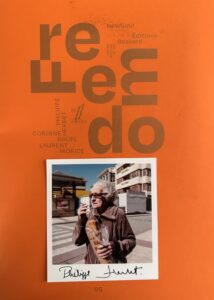
Les Filles de Tourgueniev – Philippe Herbet

The critical conditions of my awareness – Han Lei

City Portraits – Victor Enrich

Self Portraits – Giacomo Brunelli
Une ultime sélection de cadeaux de Noël pour les amoureux et passionnés de livres et d’art!

A propos des Editions Bessard

Maison d’édition d’art photographique

A la recherche de l’excellence, du beau, les Editions Bessard travaille sans relâche à la création de nouveaux codes, de nouveaux concepts avec la volonté de faire du livre de photographie, un bel objet, un livre d’artiste.

Depuis sa création, 5 collections uniques ont été créées, toutes orientées sur la photographie contemporaine nationale et internationale : la collection d’exception, limitée ou d’artistes, la zine collection et la dernière nouveauté Bespoke.

Après le succès de la zine collection, Bespoke s’est naturellement imposé dans la collection des éditions : le sur-mesure, un savoir-faire alliant parfaitement l’expertise, la tradition (du livre), le goût, l’exception et l’inventivité.

Plus d’une trentaine de livres d’artiste ont déjà été publiés : Ren Hang, Ed Templeton, Joan Fontcuberta, Pieter Hugo, Bill Henson, Bernard Plossu, Max Pam, Brian Griffin, Wang Qingsong, Liu Zheng, Chen Jiagang, Xu Yong, Roman Pyatkovka, ,

Wei Bi, 223, Eric Rondepierre…

Mêlant tradition et audace, Les Editions Bessard soutient la création et assure la promotion de ses artistes. Des jeunes talents, des artistes de renom venus de tout horizon qui reflètent la richesse, la diversité de ses choix artistiques.

En 2015, la maison d’édition va encore plus loin dans son engagement artistique en créant un partenariat avec l’hôtel Rosewood, la 1ère résidence d’artistes située à Beijing. Un lieu, un espace, une résidence pour créer de nouveaux projets et de nouveaux ouvrages.

En juin 2016, elle lance le 1erFotobook festival à Beijing avec la collaboration du festival Kassel.

Festivals, salons, workshops, nouveautés, créations artistiques, projets culturels …l’année 2017 sera riche en événements!

Plus d’infos au pierrebessard@hotmail.com

Posted on Leave a comment

Final result from contributors “The Greatest Photobooks of All Time” as a small virtual sub-bookshelf – 112 people sent in their vote – including myself. From the Top 10 only “Diane Arbus: An Aperture Monograph” missing here. All the details at: http://www.source.ie/photobook/poll_results_A.html

Happy to be a contributor to this extensive ‘best photo-books ever’ list of lists – Source magazine (Ireland).
And happy to see our books selected by Michaela Bosakova
Head of the Photon Gallery Vienna / Project coordinator for the Central European House of Photography in Bratislava, Austria

Top list: Robin Hammond, My Lagos, 2016. Nice documentary work, strong images, even though once again a classical approach, it has a well built story. Published by Éditions Bessard
IMG_2714

Posted on Leave a comment

Robin Hammond, “My lagos” One of the best PhotoBook of the year 2016…

I have been an outsider most of my life. As an immigrant or photographer in the countries where I have lived and worked, I have not truly belonged. I’ve been a foreigner for so long that I don’t really know anything else. It has become part of who I am.
In our industry, some argue, convincingly, that the most authentic stories come from people who live in the communities being documented. But that closeness can also blind a storyteller to a place’s unique characteristics. And cultural rules, which don’t always apply to an outsider, occasionally limit what can be photographed. Counterintuitively, access and seeing can be easier when you don’t belong.
In Africa’s biggest city, Lagos, I was often reminded of my foreignness. While I was welcomed as a friend many times — because that is the way guests are usually treated across Africa — I was also regarded with suspicion and aggression, because people of my skin color do not have a flattering history in these parts. Just as many doors were opened to me because I was not from there as doors were closed in my face because of what my skin color represented.

Intimacy and exclusion, love and hate, laughter and insult regularly rub shoulders on Lagos’s streets. It’s a complex place.

I was trying to grasp, through my camera, life in this massive metropolitan area of more than 20 million people. As an outsider, I needed help. My Lagosian fixer and constant companion, Yinka (who did not want his full name used), drove me through the streets and translated languages. More valuably, he guided me through the maze of a seemingly impenetrable place, unraveling the rules governing this megacity, which to an outsider just looks like chaos.

Located in West Africa’s most populous nation, Nigeria, Lagos is as much an experience as a place. The local experience and the foreign experience are certainly not the same. But that difference is not the only meaningful one. The city’s residents experience it differently: the businessman and the fisherman, the prostitute and the entrepreneur, the housewife and the bricklayer. There are more than 20 million Lagosians, and, one could say, just as many Lagoses.

It is a fascinating city, but one where life can be hard. One survey placed it as the fourth worst place in the world to call home, and another ranked it as one of the world’s most unequal cities. Yinka often remarked: “Lagos, ain’t no small t’ing,” meaning, life is not easy there. But many of the people I met also expressed how they saw Lagos as a place where dreams come true, where hard work pays off and where, with a few good connections and smarts, one can rise from the streets and into the mansions of the city’s big men.

My new book, published by Editions Bessard, is called “My Lagos,” but only partly because it is my view of the city. It comes mostly from the interviews I conducted with the subjects of my portraits. I asked them to describe what Lagos meant to them, and they would answer, “My Lagos is. …”

Their quotations in the book and their portraits connect us, in a small way, to a people most readers will never meet, and through them we experience a piece of a place most will never visit.
Photography, for me, is about connections. The design of this book is too. The vertical, large-format Polaroid portraits rest atop of and half-cover the wider horizontal photo reportage below, until the portrait is turned to reveal the entire picture underneath. The two images are separated stylistically, by the border of the Polaroid surrounding the portrait, a page fold, even different paper stock. But they are part of each other too, joined in a narrative created when the two are placed together.

Nollywood, Nigeria’s film industry, is huge on the continent, no more so than in Lagos itself. I collected Nollywood film posters as I roamed the city. The posters are cheaply produced, the postproduction often amateurish. But there is a raw, unpretentious beauty in their gaudiness, much like the films themselves. The posters become dust jackets of the book, folding around it to form a colorful introduction to the people and city of Lagos. Each book is unique in this way, and the reader gets to take home his or her own piece of Lagos. The printers we used couldn’t understand why we would want to use all these different, poorly produced posters. They wanted to print them themselves, not understanding that the authenticity and uniqueness of each poster was exactly what gave them their charm.
This book is a journey, a search for a series of pictures that capture Lagos. But it is just one view influenced by many: the Lagos I stumbled across, the Lagos Yinka introduced me to, and the Lagos described by the people in the portraits. There are infinite ways to see and experience this city, of course, so don’t get this book expecting to know Lagos by paging through it. There is no real, true knowing of a place like this. Expect, instead, the Lagos one photographer came to know and love. And what did I find? In the ugly, I found beauty; in the chaos, form; and in the voices of the people I met, I found my Lagos.”

Robin Hammond

Posted on Leave a comment

Happy to be a contributor to this extensive ‘best photo-books ever’ list of lists – Source magazine (Ireland). And happy to see our books selected by Michaela Bosakova Head of the Photon Gallery Vienna / Project coordinator for the Central European House of Photography in Bratislava, Austria Top list: Robin Hammond, My Lagos, 2016. Nice documentary work, strong images, even though once again a classical approach, it has a well built story. Take a look: http://www.source.ie/photobook/poll_results_A.html Éditions Bessard

Posted on Leave a comment

Giacomo Brunelli, the BeSpoke N°3 « Self Portraits », limited edition of 250 copies with a signed c print by the arttist, only 36€ hard cover, cloth binding…

” I started working on the Self Portraits series in 2010.
I was shooting in Italy in the summer and while looking for animals to photograph in the countryside, I looked through the camera and saw a reflection of my shadow on an unpaved road against a mountain.
It was a clear day and I was not far from the place where I was born.
From that moment, I decided to build a project on myself. No more people or animals to chase, no more sneak shots of strangers, all I needed now was right in front of me, still, posed, shouting for me to just press the button.
So for three years and hundreds of sunny days, I wandered around the countrysides of Italy and the United Kingdom, posing different shadow positions in front of the camera.
As the project progressed, I started to construct my pictures as though the shadows were an integrated element of the landscape that were coming to life because of my interaction with the environment.
Working with a removable viewfinder camera, a Miranda that once belonged to my father, the photographs were taken from a waist level perspective, casting my reflection onto natural, organic surfaces as grass, soil, rocks, hay, plants and trees.

I loved working with these textures and the way they responded to my presence and what they gave back in return, was continually fascinating.
I came across many different surfaces: green and leafy, white and rocky, yellow and grassy, brown and woody.
It was the act of casting my black presence onto colours and shapes that kept me shooting images.
Seeing my shadows distorting, taking form and coming to life against the sunshine, was like being in my darkroom, printing with hands and body, under the light of the enlarger.
Moving around while taking pictures of my shadow was like marking the territory, exploring a new, fragile dimension made out of nothing but light”.